

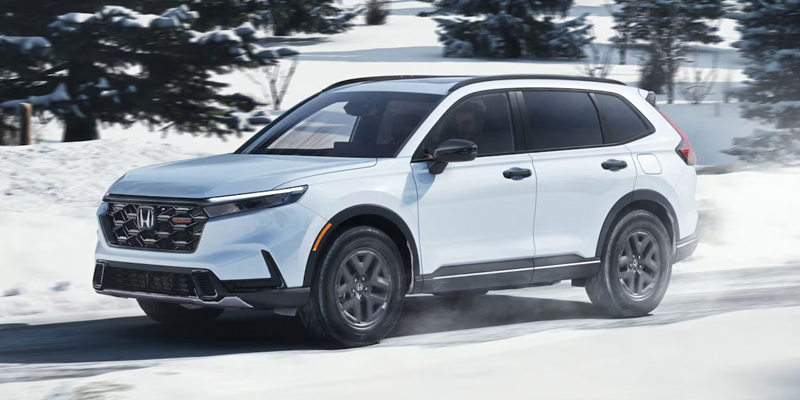
When the weather turns cold in central Wyoming, drivers face some of the most demanding winter road conditions in the country. Honda’s Real Time AWD with Intelligent Control System is engineered to handle these sudden changes without requiring any driver intervention. Unlike traditional four-wheel-drive systems that require you to manually shift transfer cases, this electronic system operates continuously and automatically behind the scenes to maintain traction on slick surfaces.
The mechanical magic of the system lies in its proactive monitoring. Sensors track wheel speed, throttle position, and steering input to anticipate slippage before it occurs. Under normal cruising conditions, the vehicle routes power to the front wheels to maximize fuel efficiency. However, the moment those sensors detect front-wheel slippage, an electronic actuator engages a multi-plate clutch to send torque to the rear wheels instantly. This seamless transfer helps prevent the vehicle from sliding when pulling away from a snow-covered intersection or climbing a slick hill.
For families navigating the high plains, this technology provides peace of mind when weather conditions deteriorate rapidly. If you want to experience how this system responds on a winter test loop, you can find our showroom at 3801 Cy Ave, Casper, WY 82604 to explore our inventory in person. If you have specific questions about how different models behave on icy roads, feel free to give our team a quick call to discuss winter capabilities.
Table of Contents
- Managing Deep Snow Drifts and High Plains Winter Conditions
- How Honda Snow Mode Adjusts Drivetrain and Throttle Calibration
- Comparing Ground Clearance: Honda CR-V vs Toyota RAV4
- Common Questions About Honda Winter Performance and AWD Capabilities
- Preparing Your Honda for Winter Driving with Your Local Casper Dealer
Managing Deep Snow Drifts and High Plains Winter Conditions
Deep snow drifts present a unique challenge on open highways and rural routes, where wind-blown powder can pile up quickly. While the standard Real Time AWD system on smaller crossovers excels at ice and light slush, larger models in our lineup utilize an even more robust system. The 2026 Honda Pilot AWD and the 2026 Honda Passport AWD feature the i-VTM4 (Intelligent Variable Torque Management) all-wheel-drive system. This advanced setup uses active torque vectoring to dynamically distribute up to 70% of the engine’s torque to the rear axle, and up to 100% of that rear torque to either the left or right wheel depending on which side has the most grip.
This capability is especially useful when trying to push through unplowed neighborhood streets or heavy snow accumulation. The extra torque sent to the wheels with traction can mean the difference between getting stuck and clearing the drift. Having a capable drivetrain is a necessity for those who commute regularly or head up toward Casper Mountain for weekend skiing.
Selecting the right vehicle configuration for these conditions depends on your typical passenger and cargo needs. To see what we currently have available, you can browse our new Honda vehicles online. If you are planning to upgrade your current vehicle before the winter storms arrive, our team can also help you value your trade-in to make the transition smoother.
How Honda Snow Mode Adjusts Drivetrain and Throttle Calibration
How does a driver optimize this power delivery when the highway is covered in hard-packed snow or black ice? Many modern Honda models come equipped with a dedicated, driver-selectable Snow Mode. When you toggle this mode using the drive mode selector on the center console, the vehicle alters several key mechanical parameters to maximize stability on low-traction surfaces.
First, Snow Mode softens the throttle response. In normal driving, pressing the gas pedal delivers immediate power, which can cause the tires to spin on ice. Softening this response ensures that engine power is applied gradually, allowing the tires to find grip. Second, the transmission adjustment is recalibrated; on automatic models, the system may start in second gear rather than first to reduce the initial torque sent to the wheels. Finally, the traction control and vehicle stability assist systems are adjusted to allow a small, controlled amount of wheel spin, which is often necessary to help the tires bite through loose snow to reach the solid ground underneath.
This electronic tailoring makes winter driving much more manageable, especially for those navigating the open plateau roads around Rawlins where crosswinds and sudden ice patches are common. If you are looking for a highly capable vehicle but prefer to shop pre-owned, we invite you to look through our selection of used cars to find an AWD model equipped with these smart driving modes.
Comparing Ground Clearance: Honda CR-V vs Toyota RAV4
A key factor in surviving a high-plains winter is ride height. Ground clearance determines whether your vehicle will ride over fresh snowfall or act as a snowplow, packing snow under the chassis until the wheels lose contact with the road. The 2026 Honda CR-V AWD features a healthy ground clearance of 8.2 inches, which is highly competitive for the compact crossover segment and sufficient for clearing moderate neighborhood drifts.
When cross-shopping, buyers often compare these dimensions to other popular vehicles in the class. The Toyota RAV4 has up to 8.6 inches of ground clearance on certain trims, which slightly edges out the Honda CR-V’s 8.2 inches. However, the Honda CR-V counters this slight dimensional difference with a highly compliant suspension and a spacious cabin featuring about 39 cubic feet of cargo space behind the rear seats, beating the Toyota RAV4’s about 38 cubic feet of rear cargo volume.
For drivers who need even more clearance and heavy-duty capability, moving up to the 2026 Honda Pilot AWD or 2026 Honda Passport AWD provides robust body-on-frame-style strength and a standard 5,000 lbs towing capacity. No matter which model you choose, protecting your vehicle’s undercarriage from road salt and gravel is crucial. You can order protective accessories, skid plates, and all-weather liners directly through our parts department to prep your vehicle for the elements.
Common Questions About Honda Winter Performance and AWD Capabilities
Q: Does Honda Real Time AWD have a manual lock button for deep snow?
No, Honda’s Real Time AWD is entirely automatic and does not feature a physical locking switch. The system relies on electronic sensors to continuously monitor wheel slippage and automatically routes torque to the rear wheels in milliseconds when traction loss is detected. This seamless operation allows you to focus entirely on steering and braking.
Q: Are winter tires still necessary if my Honda has All-Wheel Drive?
Yes, winter tires are highly recommended for Wyoming winters. While AWD is excellent for helping your vehicle accelerate and maintain forward momentum, it does not assist with stopping or steering on ice. Dedicated winter tires feature specialized rubber compounds that remain flexible in sub-freezing temperatures, providing critical braking grip on hard-packed snow and black ice.
Q: What is the difference between the AWD system in the CR-V and the Pilot?
The Honda CR-V uses Real Time AWD, which is a lightweight, fuel-efficient system that sends power to the rear wheels when the front wheels slip. The larger Honda Pilot utilizes the i-VTM4 system, which features active torque vectoring. This advanced system can proactively send power to the rear and dynamically shift torque between the left and right rear wheels to actively push the vehicle through deep snow.
Q: How does cold weather affect Honda hybrid models in the winter?
Like all vehicles, hybrids experience a temporary drop in efficiency during extreme cold. Local owners typically see a winter driving range and fuel economy reduction due to prolonged cabin heating and battery warming cycles. To maximize winter efficiency, we recommend parking in a garage when possible and using heated seats to stay warm rather than blasting the cabin heater.
Q: How do I know if my AWD system needs maintenance before winter?
We recommend having your vehicle inspected annually before the snow starts falling. Our technicians will check the rear differential fluid, inspect the transfer case, and ensure all electronic sensors are functioning correctly. You can easily schedule service online to have our certified team perform a comprehensive multi-point inspection.
Preparing Your Honda for Winter Driving with Your Local Casper Dealer
Taking the time to prepare your vehicle before the first major blizzard hits is the best way to ensure safe, reliable travel all season long. From checking battery health—which can quickly degrade when temperatures drop below freezing—to inspecting your heating system and tire tread, proactive maintenance is key. At Fremont Honda of Casper, we offer comprehensive winter preparation services designed specifically for our rugged local climate.
Our factory-trained technicians can test your battery’s cold-cranking amps, install winter-grade synthetic engine oil, top off your windshield washer fluid with a low-temp formula, and mount a set of high-traction winter tires. We are committed to keeping your family safe on the road, whether you are making the daily school run in Casper or driving through the open plains of Glenrock. As we like to say: We are your Friends. We are your Neighbors. We are Wyoming!
If you are ready to upgrade to a highly capable AWD vehicle or want to secure your winter ride, you can start the process by completing our secure finance application online. When you are ready to take a test drive, you can get directions to our dealership or reach out to our friendly sales team by calling (307) 219-1796. Let us help you drive with confidence this winter.
Connect with us

